Workshop Overview
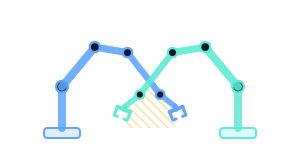
Compositional or modular learning enables systems to exploit the structure of the problem by building abstractions between functionally different components. These structural assumptions of the underlying problem help in reducing the sample complexity of the learning system.
This has led to increased adoption of compositional approaches within the robotics community, primarily due to the diversity and the lack of standardization in robot embodiments, observational modalities and task goals that make collection of data supporting all combinations difficult.
As various efforts attempt to scale data and build large foundation models, it could be argued that these foundation models approximate compositional behavior for the scaled modality, embodiment and goal combinations. However, certain modalities such as force and tactile are intrinsically difficult to scale and standardize across different setups. Moreover, human actions are highly compositional, dextrous and goal oriented, making the scaling of the training data along the skill axis a costly endeavour.
We propose this workshop to solicit novel works that use the principle of compositionality or modularity for tackling learning problems in robotics. Specifically, we encourage works that leverage the representational power of scaled systems in their approach to showcase the best of both worlds.
Focus Areas
Modality Composition
Can we develop novel modular systems that compose scaled modality representations with modules learned for the data-scarce modalities?
Interfacing Modules
How can we develop better abstractions for effective modularization in robotics, such as for long-horizon manipulation or embodiment transfer of policies?
Role of Agents in Robotics
How can we leverage modular agents to perform manipulation in the real world?

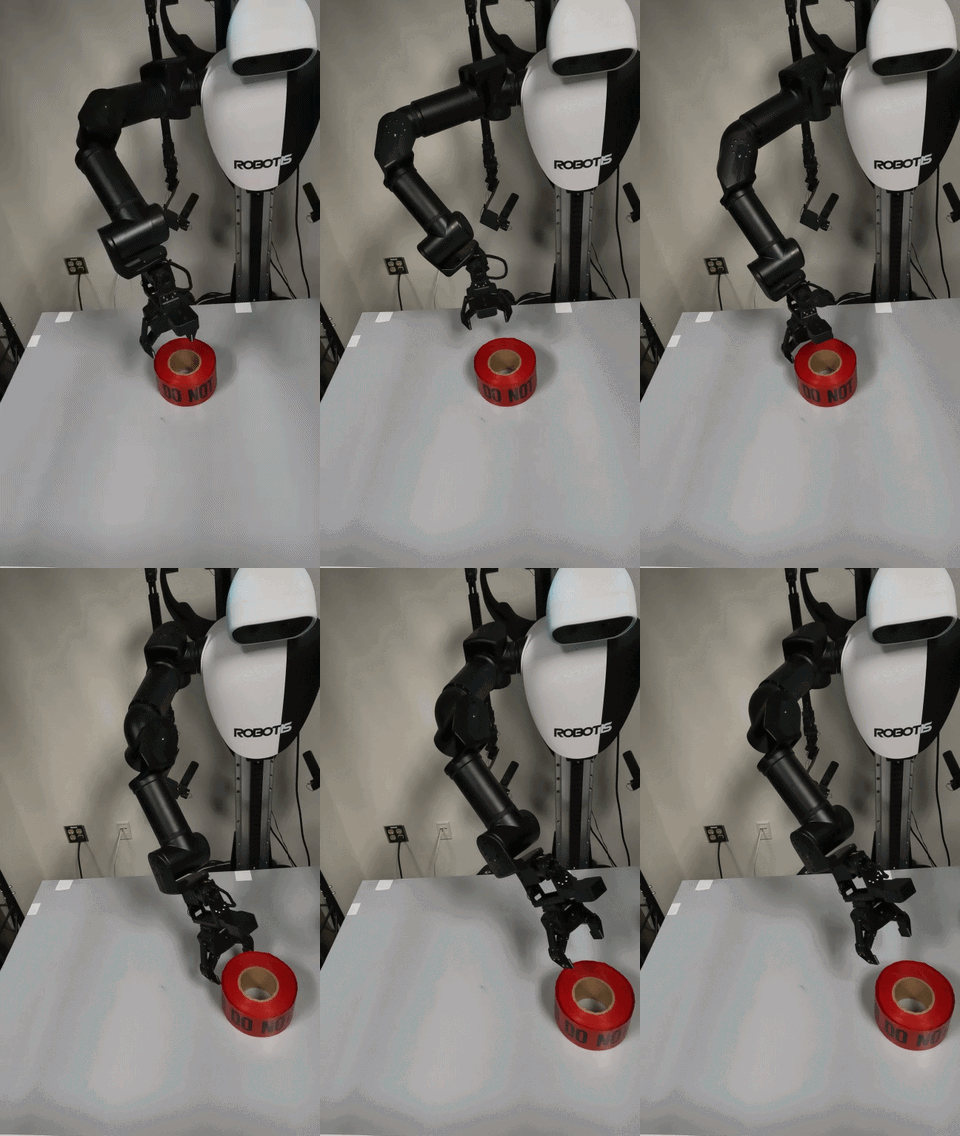
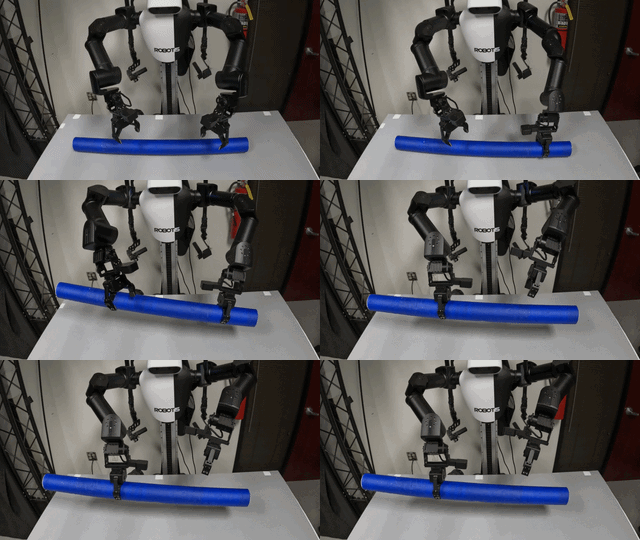
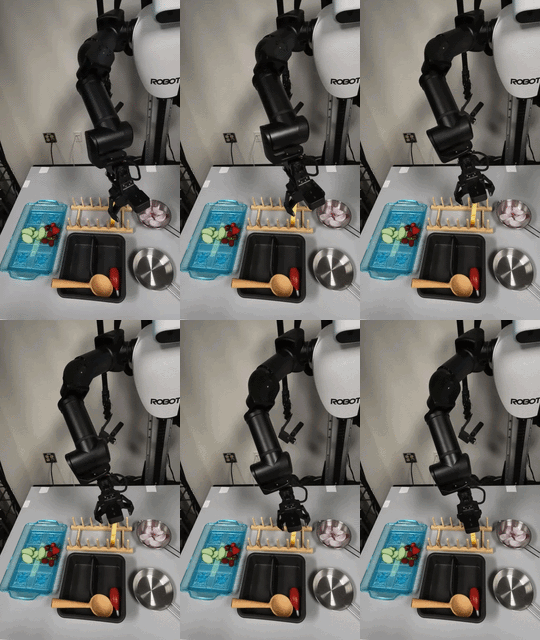
ROBOTIS is bringing its AI Sapiens platform to IROS 2026. See its AI Worker robots in action below, and visit the team at Booth 422.
Call for Papers
We invite submissions of original research papers on compositional and modular learning for robotics. Work-in-progress and position papers are also welcome.
Topics of Interest
We solicit contributions on topics including but not limited to:
- Compositional and modular learning for robotics
- Foundation models and compositionality in robotics
- Multi-modal learning with force and tactile sensing
- Modular systems composing scaled and data-scarce modality representations
- Abstractions for effective modularization in robotics
- Long-horizon manipulation with composable skills
- Embodiment transfer of policies
- Modular architectures for dextrous manipulation
- Imitation of compositional human actions
- Data-efficient learning and sample complexity in modular systems
- Modular agents for real-world manipulation
Submission Guidelines
- Format: IEEE IROS format (two-column), up to 8 pages (including acknowledgments and references)
- Archival: Workshop papers are non-archival; concurrent submissions are allowed
- Review: Double-blind peer review
- Presentation: Accepted papers will be presented as posters or spotlight talks
- Template: Use the official RAS PaperCept Template
Submission Portal
Submissions are handled via OpenReview. The portal opens July 15, 2026 and closes September 1 September 7, 2026 (23:59 AoE). Deadline extended
Important Dates
All deadlines are 23:59 Anywhere on Earth (AoE, UTC−12).
Invited Speakers
The following speakers have accepted our invitation.






Workshop Schedule
Sunday, September 27, 2026 · 8:30 AM – 12:30 PM.
Room 408/409, Level 4, West Wing
David L. Lawrence Convention Center
1000 Fort Duquesne Boulevard
Pittsburgh, PA 15222, United States
Accepted Papers
ROBOTIS Best Paper Awards — $1,200, $800 & $500 in ROBOTIS store credit. Winners highlighted below.
-
🏆 Best Paper · 1st Place · $1,200 store credit Hierarchical Control via Spectral Skills
-
🏆 Best Paper · 2nd Place · $800 store credit LiLo-VLA: Compositional Long-Horizon Manipulation via Linked Object-Centric Policies
-
🏆 Best Paper · 3rd Place · $500 store credit Language Steerable Kernels: Equivariant Language Mapping for Data-Efficient Manipulation
Organizers


Haonan Chen
Post doctorate, Harvard University & visiting post doctorate, Stanford University
haonan16.github.io